
In today’s competitive job market, especially for management students, simply attending events and sending LinkedIn requests isn’t enough. We’ve already discussed the Hiring Hierarchy, so you know to find a suitable job, you need to move from an External Candidate to a Referred one!
Many are told to “network,” but what that means in practice is often vague or uncomfortable. Students end up pitching themselves to strangers with little context and hoping for a favour rather than earning genuine interest.
But what if networking didn’t have to start with self-promotion?
What if it started with a contribution?
We believe that getting involved in small, collaborative projects, especially with small businesses, is one of the most effective (and overlooked) ways to build your professional network. Not just because it adds to your CV, but because it allows you to offer value to others. Therefore, instead of trying to be interesting, you become helpful, and people remember that.
The story that follows comes from an international management graduate. It shows how a short, academic project evolved into an unexpected opportunity, not because of a cold message, but because of curiosity, contribution, and consistency.
Exhibit Two: Networking
A few months after graduation, I started attending webinars and events to build my professional network. I wasn’t sure what I was looking for, just trying to put myself out there. In one of those webinars, someone mentioned they were starting a business in the nutrition space. That caught my attention. So, I said:
I’ve worked on a couple of projects in that industry, happy to share what I found, if that’s useful.
I wasn’t offering a CV. I was offering a conversation.
We exchanged contacts and set up a short meeting. I had no expectations, just the intention to be helpful. But while preparing, I realised they used to work at one of the Big Four consulting firms. That intrigued me! So, I added: If you’re open to it, I’d love to hear a bit about your experience there too.
Exhibit Three: The Value Exchange
In our chat, we introduced ourselves and our backgrounds. I didn’t assume I could help, I asked a few questions first to understand where they were with their company and whether anything I’d done might be relevant. We had a constructive conversation about the industry and their plans.
Afterwards, I went back to my notes and research. Some of it was outdated, so I refreshed the data and built on what we’d discussed. I sent a long follow-up email, with tailored insights and a couple of ideas they hadn’t considered yet. I wasn’t sure how it would land; it was either too much or just right. Thankfully, it was the latter. They replied appreciatively.
A few days later, my inbox lit up, they had introduced me to a strategy consultant at one of the Big Four. But this wasn’t a generic forward. It was a personal, thoughtful introduction that reflected real trust.
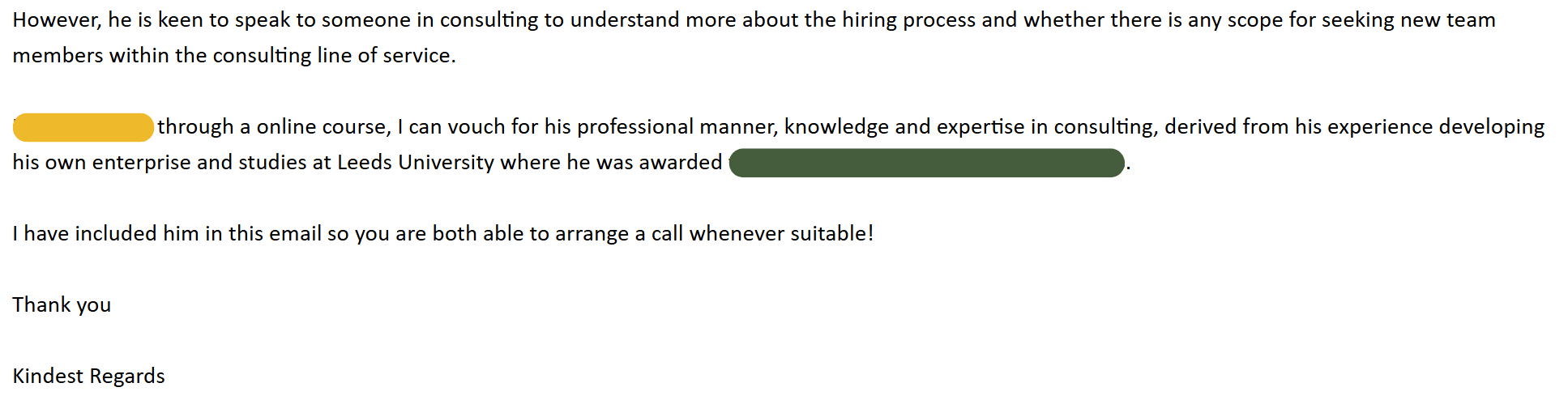
In my meeting with the consultant, I didn’t feel like an outsider. I felt prepared. More importantly, I understood the hiring process from the inside. And because of that strong introduction, they told me: ‘If there’s a fit, I’ll refer you.’”
What I learned is that networking isn’t about showing off your skills or chasing favours. It’s about creating moments of value, listening like a consultant, understanding like a partner, and showing that you’re not just looking for help, but offering it. That’s when people take notice.
Final Words
For many management students and professionals, “networking” can feel awkward or performative, a buzzword that often boils down to chasing people on LinkedIn. But this story shows that genuine connections are built differently. They start not with pitching, but with understanding: listening first, offering insights second.
This is the heart of what we call value-led networking. It’s not transactional. It’s built on the same mindset consultants use: diagnose before you prescribe. Ask before you offer.
Pro bono student projects like the one featured here are a low-stakes, high-reward way to begin this process. You get to understand a real business, sharpen your insights, and if done well, you build relationships grounded in trust, not favours.
If you’re just starting your course, you have time. You have months ahead to build authentic, strategic connections, ones that move you upward in the hiring hierarchy.
We connect students and recent graduates to businesses for short, 1:1 pro bono projects, typically lasting 2–3 weeks. And we suggest they leverage these connections to generate referrals and strengthen their CVs.